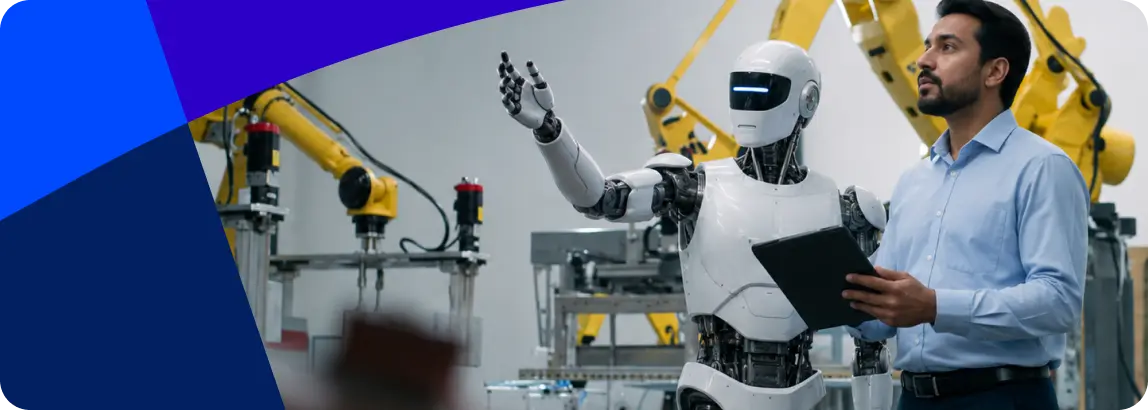

What’s the article about? Do you also want to know how Enterprise AI Agents help manufacturers optimise productivity, quality, maintenance, procurement, and supply chain operations through secure, intelligent automation? Read this article and learn more.
Manufacturers have till now, invested in automation, connected machines, and digital systems, yet many operational decisions are carried out manually between production, maintenance, quality, procurement, and planning teams.
Let’s take a situation where a machine stops unexpectedly. A quality issue delays dispatch, while material consumption exceeds expectations. Suddenly, multiple departments are exchanging emails, reviewing dashboards, and updating spreadsheets before making a decision. This is where AI automation is transforming the scene.
Unlike traditional automation, enterprise AI agents do not just identify problems, but understand the context, access enterprise data, and execute agentic workflows that can help the teams to respond faster and more smoothly. Powered by self-hosted LLMs and enterprise LLM platforms, such intelligent systems are helping manufacturers improve productivity without replacing existing ERP or MES systems.
Let's look at five real-world examples of how AI agents are addressing manufacturing challenges.
1.How Can AI Improve Plant Productivity?
Small inefficiencies go unnoticed until they affect output. The result is production losses. To cover this up, AI-powered plant productivity optimisation helps and actively monitors production data, machine utilisation, operator performance, and production schedules to identify areas for improvement. Let’s take an example:
A manufacturing plant’s one of the production lines was consistently underperforming during the evening shift. They deployed an AI agent to perform the task, which evaluated machine logs, workforce allocation, and historical production data to identify bottlenecks. It also recommended scheduling changes and resource allocation to keep the operations flowing.
At Iconflux, we create AI agents that integrate production data from ERP, MES, IoT sensors, and operational dashboards into a single decision layer. Rather than relying on separate reports, operations managers get real-time recommendations on production bottlenecks, resource utilisation, and scheduling improvements via secure enterprise AI workflows.
2.How Does Predictive Maintenance AI Reduce Downtime?
Unpredicted failures are one of manufacturing's major operational risks. Herein, predictive maintenance AI focuses on monitoring machine health by analysing sensor data, vibration patterns, temperature readings, and maintenance histories.
Instead of just sending alerts, AI agents can start intelligent workflows by creating maintenance work orders, checking spare-part availability, scheduling maintenance windows, and notifying maintenance teams.
Our predictive maintenance AI solutions constantly analyse equipment telemetry, maintenance records, and production schedules to detect any signs of equipment failure. So, rather than generating mere alerts, Iconflux’s AI agents automatically create maintenance recommendations, prioritise work orders, and integrate hassle-free with your existing systems.
3.Can AI in Quality Control Improve Product Consistency?
Quality issues prove to be more expensive, especially when they are discovered after production completion. AI in quality control combine computer vision with AI models to inspect products in real time. For example, an automotive component manufacturer can use AI-powered cameras to detect surface flaws, dimensional variations, and assembly errors during production rather than final inspection.
AI agents can flag defective batches, notify quality engineers, recommend corrective actions, and record inspection results automatically. Iconflux develops AI-powered visual inspections that not only integrate with your existing production lines but also detect defects while providing explainable insights that help to better the quality.
4.How Does AI Optimise Material Consumption?
Material waste directly impacts manufacturing profitability. For this, the AI agents analyse production history, machine settings, inventory data, and demand forecasts to optimise raw material usage. Imagine a packaging manufacturer where raw materials consumption is consistently higher than expected. Therefore, instead of manually investigating the issue, the AI agent can identify that one production line is operating with outdated machine parameters, further recommending optimised settings and maintaining product quality.
By using enterprise AI, Iconflux connects inventory systems, production planning, and machine data to identify hidden material losses. The agents continuously monitor consumption patterns and recommend operational adjustments that can improve efficiency without compromising production quality.
5.AI in Supply Chain and Procurement Operations
Manufacturing efficiency depends on more than just production. It is also dependent on reliable procurement and supply chains. AI agents improve AI for procurementand supply chain operations by connecting ERP systems, supplier databases, inventory platforms, and production schedules. Like, if a supplier delays a critical shipment, an AI agent can assess the production impact, check available inventory, recommend alternate suppliers, update procurement priorities, and notify production planners.
Our AI agents merge supplier information, ERP data, inventory levels, and production schedules into intelligent procurement workflows. This sequentially automates supplier evaluation, anticipates supply risks, and makes more timely purchasing decisions while maintaining compliance and operational continuity.
Why Are Private AI Models Better for Manufacturing?
There are so many sensitive production datasets, engineering drawings, supplier contracts, and proprietary processes that have been sent to public AI platforms, creating security and compliance concerns. This is the main reason why many are adopting an enterprise AI framework, which includes:
● Self-hosted LLM
● Private LLM deployment
● On-premises LLM deployment
● Enterprise LLM platform
These models not only allow organisations to keep business-critical data within their own premises, but also enable the power of decision-making provided by AI.
How Can Manufacturers Successfully Deploy AI Agents?
Honestly, deploying AI agents requires more than just selecting an AI model. A successful implementation further depends on the following:
| Requirement | Why It Matters |
| Reliable AI infrastructure | It supports scalable AI operations |
| Integrated enterprise data | It provides accurate business context |
| Secure LLM deployment architecture | It protects sensitive manufacturing data |
| Agentic workflows | It automates cross-functional operational decisions |
| Continuous monitoring | It maintains AI performance and compliance |
Frankly, the organisations that focus on these basics achieve better long-term results from their AI initiatives.
Why Do Manufacturers Choose Iconflux for Enterprise AI?
Many businesses fail in their AI projects as they deploy models before even preparing the underlying enterprise ecosystem. At Iconflux, we have adopted an entirely different approach. Rather than delivering standalone AI applications, we have designed enterprise AI systems that combine self-hosted LLMs, LLM deployment architecture, and your enterprise’s data pipelines into one scalable platform.
Here’s a clear way to understand it:
Enterprise AI Agents: Automate operational workflows across departments.
Self-hosted LLMs: Keep your company's manufacturing data secure and private.
AI-ready Data Engineering: Improve the use and implementation of AI (accuracy) with trusted enterprise data.
ERP, MES & IoT Integration: Seamlessly connect your existing manufacturing systems without disruption.
Agentic Workflows: Allow AI to execute business processes, not just answer questions.
Final Thoughts: Build Smarter Manufacturing Operations with AI Agents
The future of manufacturing does not involve adding more dashboards or collecting more data. It is becoming more about facilitating systems to understand operational context, automate decisions, and provide real-time support to teams.
Enterprise AI Agents make this happen through intelligent automation, secure LLM deployment, and integrated business workflows. AI agents are no longer a new technology for manufacturers looking to boost productivity and optimise overall operations. They're now a competitive advantage.
Are you ready to take that advantage for yourself? Chat with our AI experts and transform manufacturing operations into measurable business outcomes.


