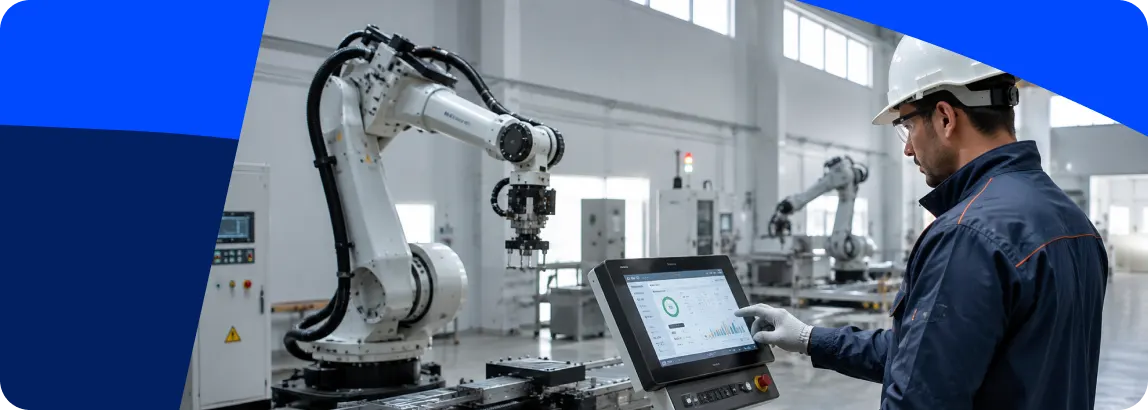

Manufacturers have been working with automation systems for a long time. Indian factories are working with robotics, CNC machines, ERP systems, and automated production lines. It helps them improve efficiency, but things are developing and changing quite rapidly with the introduction of AI in Manufacturing. Rather than execute predefined instructions,AI automation can help systems to interpret information, make decisions, and perform actions.
This development and shift matter most for India’s Tier-2 manufacturers, who have the bulk of production and require contact surveillance and analysis to check the quality. According to NITI Aayog's estimation, the AI-led productivity and efficiency improvement could contribute upto $85–100 billion to India’s manufacturing sector by 2035.
It can help in lower production costs, higher yields, improved predictive maintenance, and better quality control.
Why AI and Automation Are Coming Together
AI has opened opportunities that can help businesses to make their workflow easier, and adding it to an automation process makes it more reliable.AI and Automation add intelligence that enables systems to interpret data, recognize patterns, recommend decisions, and adapt workflows.
Let us understand it with an example comparing a traditional automated system and an AI Automation System.
| Traditional Automated System | AI Automation System |
| A traditional automated system may alert a maintenance team when a machine crosses a temperature threshold. | An AI-powered system can analyze temperature, vibration, maintenance history, production schedules, and previous failures to identify potential problems and recommend the next action. |
That is why AI workflow automation becomes valuable for connecting intelligence with the workflows where decisions actually need to happen.
Why Tier-2 Manufacturers Cannot Ignore AI Automation
The Indian government is trying to manufacture most of its production in India only to minimize imports and help the Indian economy boom. For that need a system that can work faster and in an organized way. That is why India is adopting AI at a faster rate.
According to a Deloitte study, 70% of Indian companies were using generative AI for automation, and 80% of them were actively investigating AI agents.
Tier-2 manufacturers work with small teams, numerous production processes, dispersed data, and mounting pressure from bigger clients and international supply chains. It's not always scalable to add more staff to handle every operational task.
A competitive gap results from this. Manufacturers can gain operational advantages before AI becomes a standard expectation throughout their supply chains if they begin developing automatic AI capabilities now.
Where AI Automation Can Create Impact
AI for Operations
AI can support production planning, analyze production data, spot bottlenecks, and assist operations teams in making decisions more quickly. Instead of requiring managers to manually compare reports, it can connect data from ERP, MES, IoT, and production systems.
Predictive Maintenance AI
AI is able to identify patterns in machine data that could indicate possible malfunctions. This can lessen unplanned downtime and support proactive maintenance planning.
AI in Quality Control
AI-based inspection and computer vision can assist in more reliably identifying quality problems, process variations, and product flaws. This may facilitate root-cause analysis and quicker inspection.
AI for Supply Chain and Procurement
AI can help improve supply chain and procurement decisions by analyzing demand, inventory, supplier performance, lead times, and material requirements.
Agentic Workflows
Agentic workflows are the next stage, in which AI agents can comprehend a business goal, obtain pertinent data, organize several tasks, and initiate actions throughout enterprise systems.
For example, an AI agent can detect an inventory shortage, verify existing stock, examine outstanding purchase orders, evaluate supplier lead times, and send a recommendation to procurement.
| AI Automation Use Case | What It Can Improve | Real-World Evidence |
| AI for Operations | Production monitoring, bottleneck identification, process optimisation and throughput | MG Motor India used IoT data analytics and digital simulation to identify production-loss root causes and reported a 15% increase in paint-shop throughput. |
| Predictive Maintenance AI | Early fault detection, maintenance planning and equipment uptime | Tata Steel reports more than 558 AI models across areas including predictive and prescriptive maintenance, process control and procurement analytics. |
| AI in Quality Control | Defect detection, process quality and inspection consistency | Mahindra & Mahindrareports AI-enabled weld-spot integrity initiatives and a self-healing paint shop using AI agents for anomaly detection and root-cause recommendations. |
| AI for Energy Management | Energy efficiency and plant-level optimisation | Mahindra reports that its Energy.AI initiative is targeting 8–10% improvement in energy efficiency at its Chakan plant. |
| Agentic AI & Workflow Automation | Maintenance workflows, decision support and autonomous task execution | Tata Steel announced deployment of 300+ specialised AI agents across its global value chain, including applications such as asset maintenance and operational execution |
| AI & Industrial Data Connectivity | Maintenance workflows, decision support and autonomous task execution | Hyundai Motor India has connected2,000+ critical machines through an industrial data network to support predictive maintenance, automated quality control and faster production decisions |
AI Automation Requires More Than an AI Tool
Installing an automated AI tool is not enough for a successful implementation. Reliable data, system integration, security, governance, and well-defined workflows are essential for manufacturing companies.
For this reason, enterprise AI integrates AI programs with the enterprise systems and data that underpin them. Data engineering, AI agents, workflow orchestration, RAG, MLOps, and integration with current manufacturing infrastructure may be necessary for an effective AI solution.
AI-based predictive maintenance and machine vision are two examples of advanced manufacturing technologies that need to be made more accessible throughout the value chain, especially for MSMEs, according to India's NITI Aayog.
Also want to know about
How Enterprise AI Agents Automate Vendor Evaluation and Procurement Workflows
Read MoreThe Next Automation Advantage
Automation is no longer a concern for Tier-2 manufacturers. The question is whether their current automation can develop the intelligence required to carry out workflows and support decisions.
Early development of this capability allows businesses to transition from rule-based automation to connected, adaptive operations. Manufacturers can transform their current data and automation infrastructure into a basis for more intelligent production, maintenance, quality, procurement, and supply chain management with the appropriate AI for Enterprise strategy.
AI is becoming the intelligence layer that takes automation to its next stage.


