
What’s the article about? This article looks at how AI for finance can help manufacturers improve financial reporting and risk management. It explains how Enterprise AI connects financial and operational data to help make faster, more informed financial decisions.
From a finance point of view, a tier-2 manufacturer has only one problem, i.e., connecting financial information with what is actually happening on the factory floor. Data is scattered; for example, invoices sit in one system, purchase orders in another, inventory data in the ERP, production information elsewhere, and budgets are often managed through spreadsheets. Teams spend half the time reconciling information before even acting on it.
Enterprise AI addresses this by connecting data, automating repetitive financial processes, identifying exceptions, and assisting teams in making faster decisions. Overall, AI solutions for finance simply transform dispersed data into one attribute, making finance more predictive, connected, and operationally useful.
How Is AI Used in Finance?
So, AI for financial reporting acts as a bridge between financial and operational data, answering questions that traditional reporting may literally take hours to resolve. For instance,
Question: Why did production costs rise by 12% this month?
AI will compare the material prices, purchase orders, production volumes, inventory movements, and historical costs to identify potential drivers. This will allow teams to move from manually finding information to interpreting it.
Which Finance Processes Can AI Automate?
For any tier-2 manufacturer, it’s always the mundane, repetitive tasks that take time to complete. AI helps by processing high-volume data where errors or delays directly affect cash flow.
Below are some of the processes that Iconflux’s AI deployment can easily automate for your understanding:
| PROCESS | THE ROLE OF AI |
| Invoice Processing | This involves extracting invoice data, matching records, and flagging discrepancies |
| Financial Reporting | Consolidates information and generates report summaries |
| Budget Management | Tracks spending against budgets and identifies variations |
| Accounts Receivable | Identifies payment patterns and potential collection risks |
| Financial Risk Management | Detects unusual transactions and financial inconsistencies |
| Accounting | Automates data classification, reconciliation, and routine checks |
Not only doesAI for accounting benefit teams, but those who rely on manual processing of such tasks now have more time to focus on other strategies and tasks.
How Does AI Improve Financial Reporting?
There is a fine line between what happened and why it occurred. While traditional reporting focuses on the "what," enterprise AI seeks to decode the "why," which is critical. An AI-powered reporting system brings together revenue, production costs, inventory, procurement, and other business information to identify the bottlenecks and generate explanations that make sense.
Continuing with the previous example, instead of simply showing that material costs increased by 12%, AI can help evaluate whether the increase is due to supplier pricing, increased consumption, changes in production volume, or other operational factors.
This itself makes AI for financial reporting valuable for faster work and better management.
Can AI Improve Budget Management in Manufacturing?
Yes, 100%. Manufacturing budgets are changing constantly due to work volume and demand-supply fluctuations. AI for budget management is another revolution that constantly compares actual spending to planned budgets and emphasises various deviations.
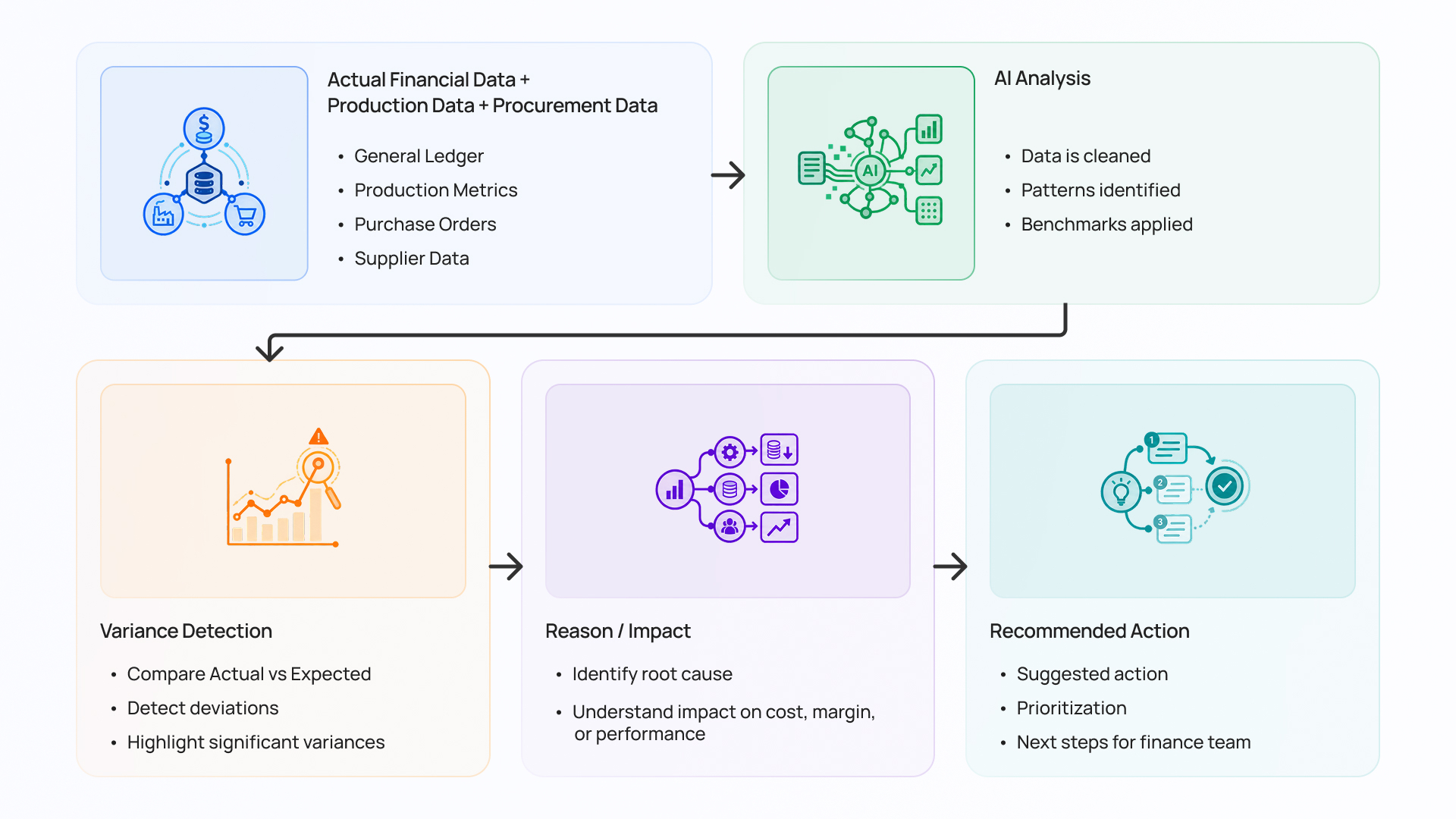
Here, the goal is not to replace your current financial procedures. Rather, it is to make your existing system more accessible and actionable.
How Can Artificial Intelligence Improve Financial Risk Management?
Financial risks arise as a result of a thousand things, including forgotten payments, supplier changes, customer payment behaviour, duplicate invoices, or unexpected cost movements.
AI for financial risk management is so well trained to work that it can continuously analyse transaction patterns and identify anomalies for further investigation. However, enterprise finance AI should not be used without NIST's AI Risk Management Framework. It recommends managing AI with functions like Govern, Map, Measure, and Manage, with governance integrated throughout the AI lifecycle.
What Does an AI-Powered Financial Architecture Look Like?
A simple yet practical implementation is that it can connect a manufacturer's existing systems like this:
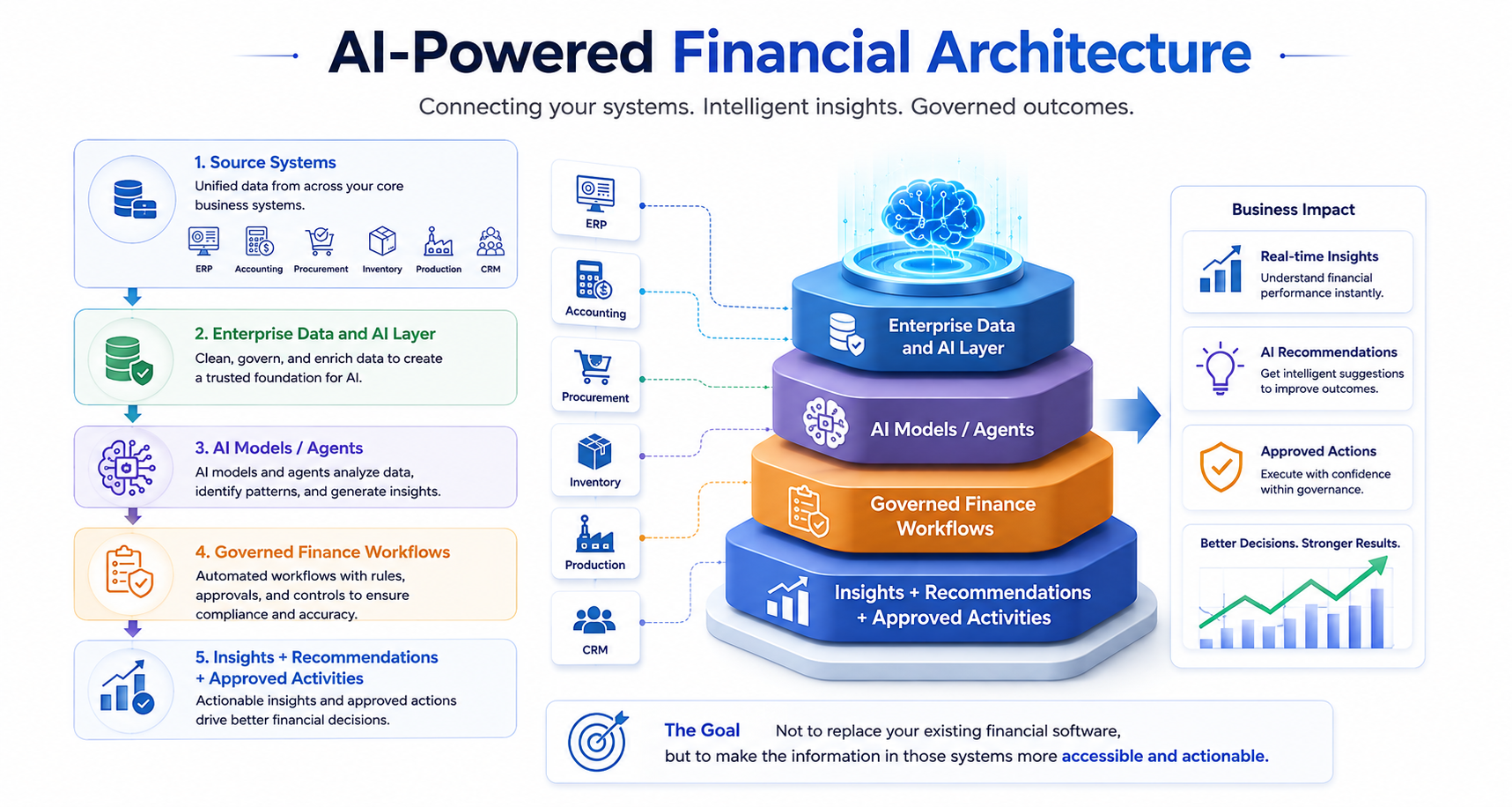
The goal isn't necessarily to replace existing financial software. The goal is to make the information in those systems more accessible and actionable.
How Does Iconflux Help Manufacturers Transform Finance Operations?
At Iconflux, we have a clear objective. It is to base enterprise AI on systems that require scalability and profitability. Not only that, but we help businesses create a structured workflow while focusing on the most important tasks rather than losing energy on tedious tasks.
Our approach brings together your existing workflow, AI solutions for finance, data engineering, AI automation, and enterprise integrations. This helps manufacturers address practical financial challenges, from invoice processing and reporting to budget management and risk analysis.
The final outcome is a finance function that acts on data rather than spending time collecting and reconciling it.
What Is the Future of Finance Operations in Manufacturing?
Enterprise AI is moving manufacturing finance beyond reporting and manual reconciliation. The coming wave of financial operations is all about automation, predictive analysis, connected enterprise data, and governed AI decision support.
The goal, specifically for tier-2 manufacturers, is not to simply automate everything. It is to identify areas where finance teams spend time, apply AI where it can add measurable value, and then grow from there.
So, are you ready to build AI for your factory? Move beyond generic AI with systems catered to your manufacturing data, workflows, and business objectives. Let's create something that your business requires.


