
What’s the article about? This article will show you how Iconflux creates governed agentic AI systems to help tier-2 manufacturers automate supply chain planning, procurement, inventory, and production workflows.
Agentic AI has the power to transform the reactive procedure of supply chain planning into an intelligent workflow system. For a tier-2 manufacturer, this is far too effective. For instance, if a supplier fails to deliver the material, inventory falls below the required level, demand shifts, or a machine fails unexpectedly, your AI agent might’ve already anticipated the situation and might be making governed decisions ahead of time.
An agentic AI system employs specialised AI agents that continuously monitor supply-chain conditions and act in accordance with originally stated business objectives. However, connecting an LLM to an ERP is not enough to build such a system. Iconflux makes it happen by combining AI automation, reliable data, agentic workflows, governance, and controlled access to business systems.
How is Agentic AI Built for Supply Chain Planning?
It all starts with connecting the existing information data source with the AI system. The AI then uses that information to understand a situation, evaluate all the possible factors, and prepare an action plan. All this is executed keeping AI governance in mind.
Here’s a visual representation of how the flow works:
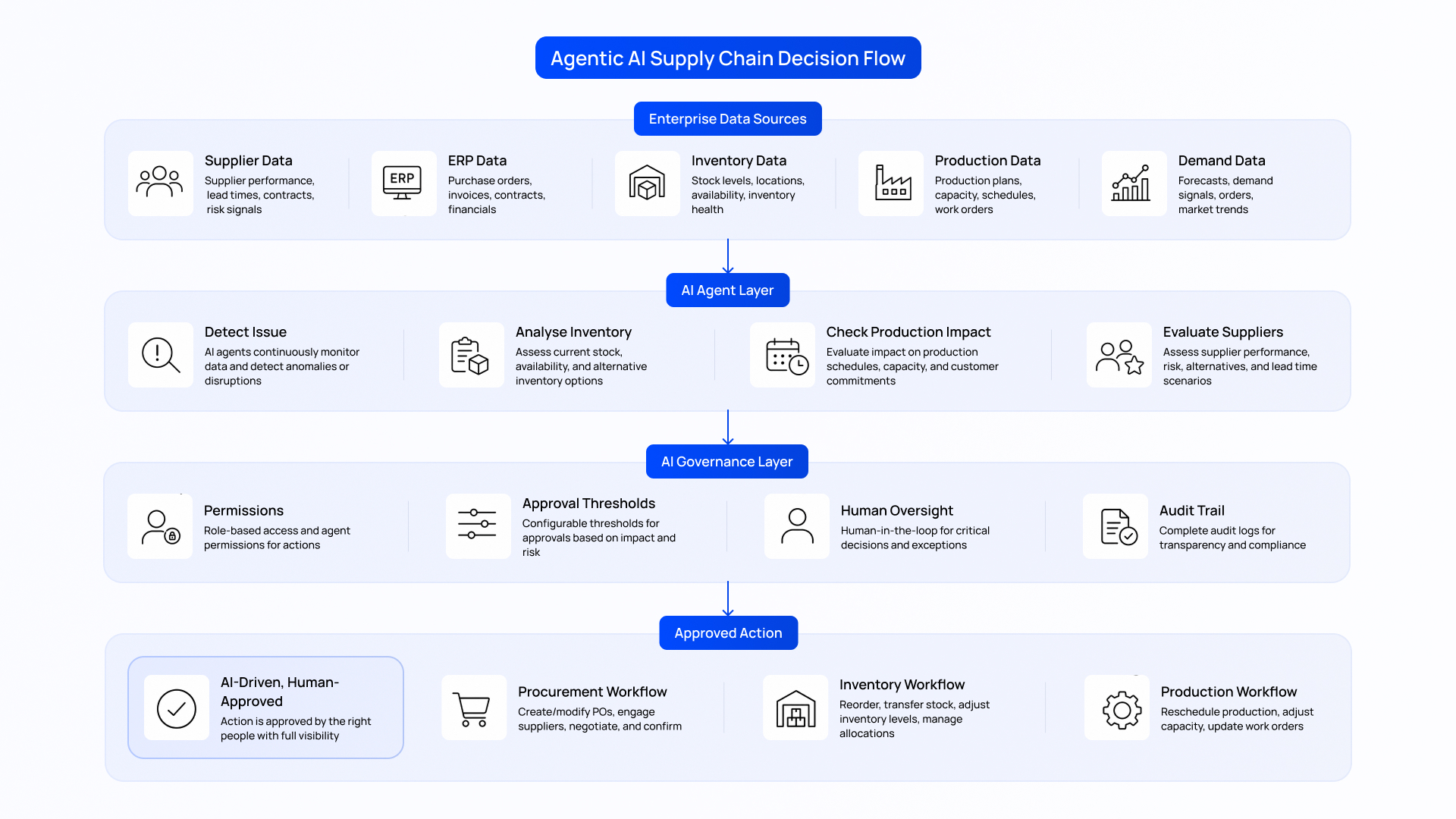
Let's figure out what this diagram is trying to convey.
Imagine a situation where a supplier notifies the team that a component will be delivered two days late. While a human intervention may appear chaotic, the AI system will not simply send an alert, but will follow these four steps:
● The AI agent will first detect the delay from the supplier or the ERP system.
● It will check current inventory to determine how many days of stock are available.
● Then, it will look at the production schedule to identify which orders could be affected immensely.
● After this, the agent will check the approved alternative suppliers, compare availability, and recommend the best available solution at that moment.
It is important to note that before making any decision, the AI governance is administered to check if a specific action is within the agent's permissions and predefined limits or not. Only after the approval is granted will the recommendation be implemented.
How Does Iconflux Deploy Agentic AI for Smarter Supply Chains?
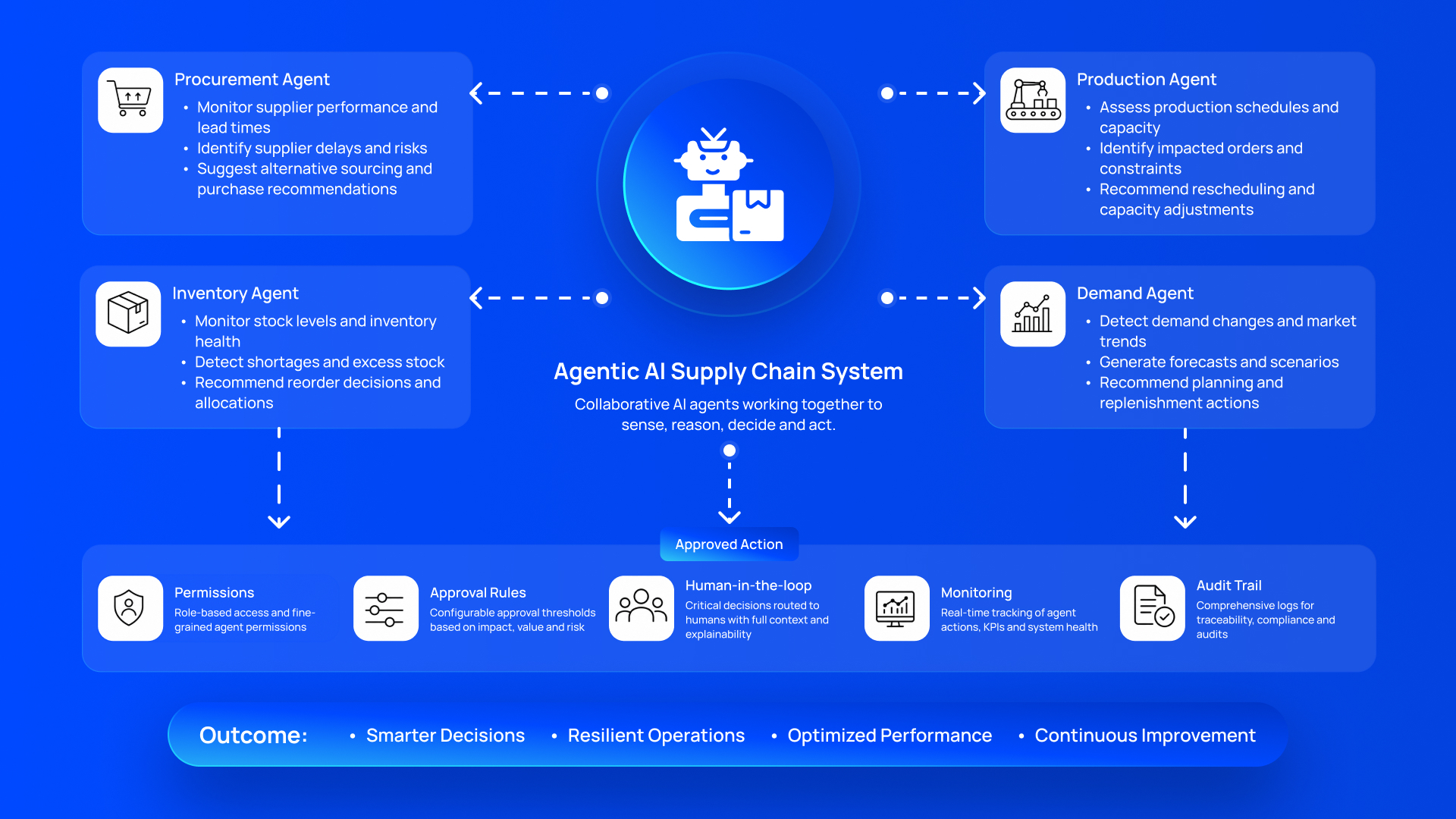
AI automation deployment requires sleek expertise to implement. At Iconflux, the approach to deploying agentic AI is to build an enterprise system rather than just a chatbot on top of existing software.
The system is based on a manufacturer's current ERP, procurement, inventory, production, and supplier data. The approach combines AI process automation, enterprise data engineering, AI models, and AI workflow automation to generate agents with specific roles, permissions, and business goals.
There are a few steps that will explain to you how we at Iconflux carry out the procedure:
1. Identifying the Planning Problem
It begins with identifying supply-chain decisions that seem to be repetitive, time-sensitive, and appropriate for AI automation.
2. Connecting the Enterprise Data
We combine your existing ERP, inventory, supplier, production, and demand data from the agent's operational context into the agentic workflows.
3. Creation of Specialised Agents
Instead of creating a single general-purpose AI for supply chain management, we also create agents for procurement, inventory management, and production coordination. This makes things easy, organised, and coordinated.
4. Implementation of Governance Controls
Permissions, approval thresholds, monitoring, auditability, and human oversight are all essential components of the workflow.
5. Automation of the Approved Actions
Agents start working on predefined workflows and escalate high-risk decisions to the appropriate employee.
6. Monitoring and Improving the Process
Performance, exceptions, decisions, and business outcomes are continuously evaluated.
What Role Does AI Governance Play in Agentic Supply Chains?
AI governance is the rulebook for AI agents and their workflow, similar to how you were given student handbooks in school that outlined the rules and regulations to be followed on campus. AI governance helps companies manage risks like data leaks and other safety measures.
There is a fundamental distinction between AI automation and uncontrolled automation. Per the AI governance rules, an AI agent should not have unlimited authority. Its actions should be limited by role-based access, approval thresholds, business rules, audit trails, monitoring, and escalation protocols.
For instance, agents can identify shortages, check approved suppliers, and recommend alternatives, but they shouldn’t independently approve a high-value supplier without human or higher-authority authorisation.
Not only does this make agentic workflow automation useful in manufacturing, but it also enables businesses to automate repetitive decisions while leaving high-risk actions to humans.
Why Is This Approach Better for Tier-2 Manufacturers?
Yes, integrating AI into existing business systems and processes is by far the most popular approach for enterprise workflow automation. This allows tier-2 manufacturers to adopt AI and automate the decisions that cause the most operational bottlenecks.
With the right AI automation services, a manufacturer can begin with one workflow, such as supplier delay management or inventory planning, and then expand further into predictive maintenance, procurement, and quality control as the system demonstrates its value.
Build an Agentic Supply Chain With Iconflux
Agentic AI is 100% your partner in seeing a problem, understanding it, recommending a solution, and taking the appropriate action under controlled conditions. Iconflux assists manufacturers in establishing that foundation through AI automation, enterprise data integration, governed agentic workflows, and intelligent decision systems.
Therefore, the goal is not to replace your supply chain team, but rather to provide the team with an AI workforce that continuously monitors the operation, handles routine decisions, and notifies the appropriate people of exceptions.
So, are you ready to transform supply chain complexity into intelligent action? Contact Iconflux to design agentic AI workflows for your manufacturing operations.


