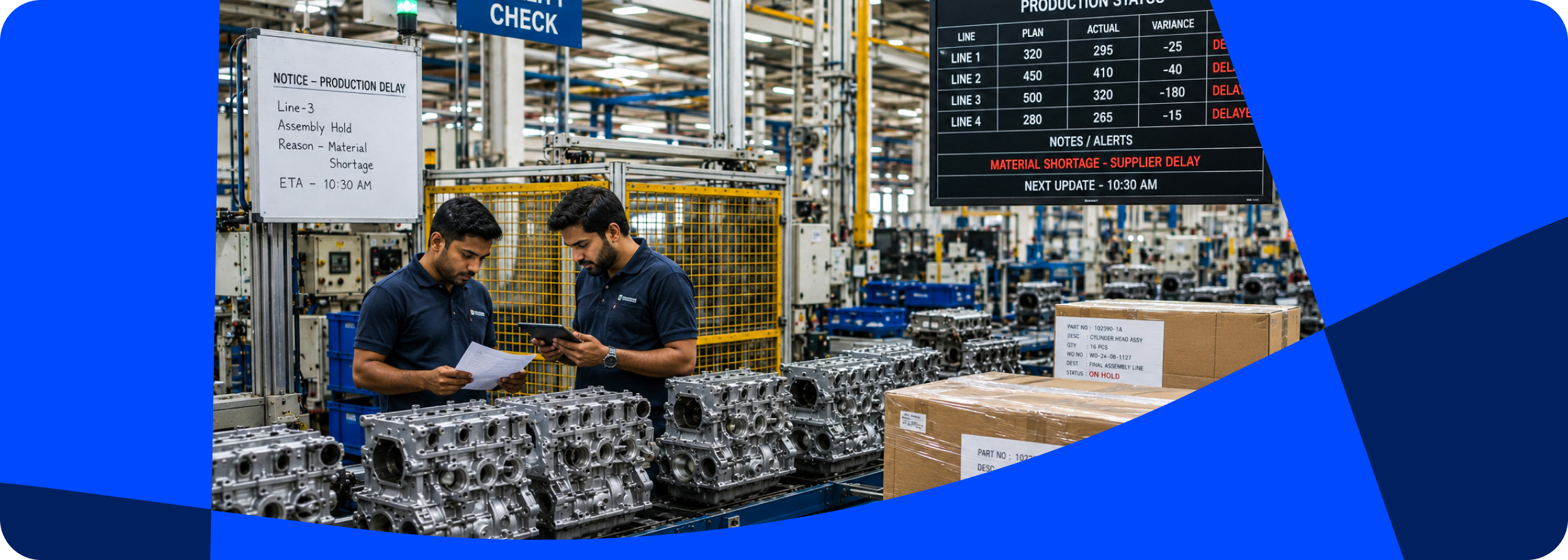

The most common challenges Manufacturing companies face are the production delays. It can cause due to many reasons such as delayed raw material shipment, unexpected machine breakdown, inventory shortage, quality issue or inefficient workflow. These reasons can disrupt the entire production schedule and directly impact profitability. That is why many big industries are slowly integrating enterprise AI in manufacturing stations, and it is assisting them in better production, good quality and systematic work.
But these challenges are still managed through spreadsheets, manual coordination, disconnected systems, and reactive decision-making by many Tier-2 manufacturing companies. Now, modern manufacturing demands greater speed, visibility, and operational intelligence, as these methods may have worked in the past.
This is where Enterprise AI is transforming the industry.
AI is being used by today's top manufacturers to automate operational workflows, anticipate issues before they arise, maximize resource use, and enhance decision-making throughout the factory floor. Reduced delays, increased output, and improved operational efficiency are the outcomes.
Why Production Delays Continue to Impact Manufacturers
It is rare for a single problem to cause production delays. Delays typically result from a mix of operational difficulties like:
- Material shortages
- Supplier disruptions
- Equipment failures
- Quality defects
- Inefficient shift planning
- Poor inventory visibility
- Delayed procurement decisions
- Lack of real-time operational data
Large amounts of data are available to many manufacturing companies, but they are frequently dispersed throughout ERP systems, inventory platforms, procurement systems, quality records, and production reports.
Teams spend valuable time responding to issues rather than preventing them when they lack a cohesive view of operations.
How Enterprise AI Changes Manufacturing Operations
Enterprise AI can analyze data from several departments and operational systems at once, in contrast to conventional automation systems.
AI gives businesses real-time visibility into plant operations and facilitates quicker and better decision-making by tying together production, inventory, procurement, maintenance, quality, and supply chain data.
This makes it possible for manufacturers to transition from reactive to intelligent and predictive operations.
Manufacturers can decrease delays and enhance overall plant performance by combining AI automation, operational intelligence, and workflow orchestration.
AI in Supply Chain Management Improves Operational Visibility
Supply chain disruption is one of the most frequent reasons for production delays.
Production schedules can be rapidly impacted by inventory shortages, erroneous demand projections, and late supplier deliveries.
Manufacturers can obtain real-time visibility into supplier performance, logistics activity, inventory movements, and procurement workflows by utilizing AI in supply chain operations.
Modern AI supply chain management systems help businesses:
- Predict supply chain disruptions
- Improve demand forecasting
- Optimize inventory planning
- Monitor supplier performance
- Improve production scheduling
Because of this, manufacturers are able to detect risks earlier and address them before delays affect business operations.
AI for Inventory Management Prevents Production Interruptions
Another significant factor causing manufacturing delays is inventory problems.
Due to poor planning, many companies either have excess inventory or experience stock shortages.
Organizations can maintain ideal inventory levels by using AI for inventory management to examine production schedules, supplier activity, past demand trends, and operational needs.
Similarly, AI in inventory management helps manufacturers prevent stockouts, reduce excess inventory, improve material availability and support production continuity.
Production becomes more dependable when inventory decisions are made with greater intelligence.
Predictive Maintenance AI Reduces Unplanned Downtime
Production lines may stop due to unforeseen equipment failures.
Conventional maintenance methods frequently depend on set timetables or reactive fixes following malfunctions.
Manufacturers can continuously monitor machine behaviour, operational conditions, and equipment performance with predictive maintenance AI.
AI is able to spot unusual trends and possible problems before they arise.
This helps organizations reduce downtime, improve equipment reliability, lower maintenance costs, and improve production continuity.
Predictive maintenance has emerged as one of the most beneficial uses of artificial intelligence for manufacturing.
AI in Quality Control Minimizes Production Rework
Production delays are frequently concealed by quality-related problems.
Rework requirements, defective products, and unsuccessful inspections can affect delivery schedules and raise operating expenses.
Manufacturers can monitor production processes in real time and detect quality risks much earlier by using AI in quality control.
AI-powered quality systems help businesses:
- Detect defects faster
- Improve product consistency
- Reduce scrap generation
- Improve compliance and quality standards
Manufacturers can maintain more efficient production processes and quicker order fulfillment by minimizing quality-related disruptions.
AI for Procurement Accelerates Operational Decisions
Delays in procurement frequently have an impact on manufacturing operations as a whole.
Production can be greatly slowed by waiting for purchase orders, supplier approvals, or sourcing decisions.
Manufacturers can automate contract reviews, supplier assessments, purchase approvals, and procurement workflows by usingAI for procurement.
AI-driven procurement systems help organizations:
- Improve sourcing efficiency
- Reduce procurement cycle times
- Enhance supplier visibility
- Improve purchasing decisions
This ensures that vital resources are accessible when production teams require them.
AI Automation Creates Connected Manufacturing Operations
Because departments operate independently, there are a lot of operational delays.
Teams in charge of production, procurement, inventory, maintenance, and quality frequently rely on manual communication and distinct systems.
AI automation uses operational visibility and intelligent workflows to link these functions.
For example:
- Inventory shortages can automatically trigger the procurement actions.
- Maintenance alerts can automatically generate the service requests.
- Quality issues can immediately trigger the corrective workflows.
- Production schedules can be instantly updated in response to supply chain disruptions.
As a result, the manufacturing environment becomes more responsive and flexible.
Why Tier-2 Manufacturers Cannot Afford to Wait
Big manufacturing companies have already started incorporating industrial AI into their supply chains, operations, quality control, and maintenance systems.
Nonetheless, a lot of Tier-2 manufacturers continue to mainly rely on manual procedures and disjointed operational data.
AI-enabled manufacturers are becoming more and more different from traditional manufacturers.
Reactively operating businesses may experience higher operating costs, more downtime, slower decision-making, lower productivity, and decreased competitiveness.
Manufacturers are creating operations that are smarter, faster, and more resilient by investing in enterprise AI.
How Iconflux Helps Manufacturers Build AI-Driven Operations
Iconflux assists manufacturing companies in deploying scalable and safe AI solutions made for actual industrial settings.
Iconflux helps manufacturers minimize delays and enhance operational performance through enterprise AI, AI workflow automation, predictive analytics, intelligent supply chain systems, procurement automation, and operational intelligence.
Iconflux assists companies in building linked and intelligent manufacturing ecosystems, whether the objective is enhancing inventory visibility, putting predictive maintenance AI into practice, bolstering quality control, or automating procurement workflows.
The Future Belongs to AI-Enabled Manufacturers
Production delays are now a competitive disadvantage rather than merely an operational issue.
Businesses that use AI can anticipate disruptions, automate processes, maximize resources, and make better decisions more quickly than ever before.
Businesses that combine manufacturing and artificial intelligence will be better positioned to scale, compete, and expand as the manufacturing sector continues to move toward digital operations.
The adoption of AI by manufacturers is no longer a question.
The real question is: Can manufacturers afford not to?


